



Co-written by Chad Carlberg & Anders Karlsson
Product Specialist & Product Specialist
Thomson Industries, Inc.
www.thomsonlinear.com thomson@thomsonlinear.com
Thomson Industries is seeing a increasing customer demand in specifications for linear actuators for higher ingress protection (IP) ratings. At the same time there is also a greater interest in more advanced controls for this type of linear motion. What is driving these trends and how manufacturers are adapting their products in response?
For years industrial actuators have needed to survive harsh environments. The minimum environmental requirements are becoming more rigorous for applications in agriculture, construction, garden, health and fitness, medical and industrial. The IP rating system remains the same: so what is changing and why?
The IP rating specifies the degree of environmental protection an electrical enclosure has against intrusion by foreign bodies and moisture. The first digit indicates the level of protection against solid objects and the second digit indicates the level of protection against liquids. Table 1 defines what each rating number means.
|
IP Rating |
First Digit Ingress of solid objects |
Second Digit Ingress of Liquids |
|
0 |
No Protection |
No Protection |
|
1 |
Protected against solid objects over 50mm |
Protected against vertically falling drops of water or condensation |
|
2 |
Protected against solid objects over 12.5mm |
Protected against falling drops of water, if the case is disposed up to 15 degrees from vertical |
|
3 |
Protected against solid objects over 2.5mm |
Protected against sprays of water from any direction, even if the case is disposed up to 60 degrees from vertical |
|
4 |
Protected against solid objects over 1.0mm |
Protected against splash water from any direction |
|
5 |
Limited protection against dust ingress (no harmful deposit) |
Protected against low pressure water jets from any direction. Limited ingress permitted |
|
6 |
Totally protected against dust ingress |
Protected against high pressure water jets from any direction. Limited ingress permitted |
|
7 |
N/A |
Protected against short periods of immersion in water |
|
8 |
N/A |
Protected against long, durable periods of immersion in water |
|
9k |
N/A |
Protected against close-range high pressure, high temperature spray downs |
For dusty applications IP54 is usually the minimum rating as it offers limited protection against dust. However, in areas with more substantial detritus, such as woodworking or paper manufacture, IP65 may be suitable as it allows for complete protection against ingress of solid objects. For an outdoor application, IP66 may be required to withstand heavy rain. However, if an actuator is going to see momentary immersion in water, IP67 is required.
For applications where liquid ingress is of more concern, ratings such as IP69 are more appropriate. Typically in areas such as mobile off-highway vehicles and machines that require high pressure, high temperature wash-downs then the higher IP rating is more of a requirement. Many large farm and construction equipment manufacturers have also moved to this requirement as machines are more commonly washed down with high pressure equipment.
A common misconception with IP ratings is that a higher IP rating number is automatically better. This is not necessarily the case as a device rated to IP69K does not automatically meet IP67. Equally, IP67 does not necessarily meet IP66. Each rating is designated by unique tests that are not cumulative, for example tests up to IPX6 are carried out on a static product where the water is splashed or sprayed around the product but does not get tested for submersion unlike a test for IPX7 or IPX8. The intensity of the direct spray ranges from falling drops of water through to a equivalent of a fire hose directed at the product from specific angles. Tests for IPX7 and IPX8 involve complete immersion in water, which is different to IPX6 tests that only test for direct spray. The dynamic nature of the IPX6 tests may mean it is possible for the jet of water to force its way past a seal that works well under the static loads of immersion.
With many OEMs in the mobile off-highway machinery, construction and agriculture markets, standard specifications are now calling for IP69K. One factor that is driving this increased requirement is the fact that more intelligence is also being added locally to actuators and there is concern that there is greater risk of exposing electronic components to moisture.
More intelligent actuators
Actuators used to be controlled by changing the current direction to run the actuator in and out. Although simple, this method of control leaves a number of process difficulties such as: what happens if you do not switch the actuator at end of stroke; how do you know the position of the actuator, and the need to accommodate thick cables between the control and the actuator in heavy duty applications. Over the years these problems have been addressed with solutions such as limit switches, overload clutches and overcurrent trip mechanisms to save the actuator at the end of stroke. Positioning can further be controlled using a potentiometer with encoder feedback for an absolute or calculated position. High current switching was also moved inside the actuator with low level switching outside.
Modern actuators are available with sophisticated control circuitry enabling optimized motion that is verified and safer. The intelligence within the actuator means it can provide features such as load monitoring, mid-stroke overload sensing, slow start and accurate positioning.
These intelligent actuators can be programmed internally to solve tasks, similar to a traditional actuator, or can be controlled over a communications bus by a central control system. A central control system gives great versatility and allows different application needs within the machine or machine range to be met by mechanically familiar actuators.
Actuators connected to a communications bus provide the means for a control system to monitor position, status, speed and force. Diagnostic and error information fed back to the operator can identify problems and warn if the actuator needs replacing in the near future. The internal intelligence within the actuator also replaces ancillary items such as limit switches and removes the need for large cables to be routed through the machine. There is no need for relays and MOSFETs, no high current spikes, low power demand and lower energy used. This makes the installation more compact and gives engineers a greater freedom in design to improve areas such as ergonomics and add richer sets of features.
Having an actuator carefully controlled via a communications bus also means that it can be installed further away from the operator. This enables advanced control in harsh environments without exposing people to potentially hazardous conditions.
Manufacturing the modern actuator
As markets specify higher protection levels for actuators and require greater intelligence, what challenges does this present to manufacturers? Space is needed within the actuator to house electronics and moisture levels need to be considered with cycling temperatures, requiring a vent and seal system that can withstand necessary IP testing.
Actuators are most vulnerable when they are extended and the integrity of the seal between the housing and the rod is tested. A wipe bridge cleans as the rod moves back and forth to prevent ingress into the housing. Many specifications also call for wider temperature ranges and this impacts the choice of materials for the wiper and seal. It is difficult for manufacturers to achieve IP67 or IP69K, thus most products on the market place have a rating of IP65.
As well as tougher IP ratings, many OEMs in areas such as agriculture also require resistance to chemicals such as fertilizers, hydraulic fluids and brake fluids. These can be aggressive to plastics and metals and make the choice of seal material critical.
Manufactures like Thomson Industries offer actuators that meet IP66, IP67 and IP69K to suit such application needs. The Thomson product engineering team use extreme test conditions to verify the robustness of products such as their Max Jac® and Electrak® Throttle actuators that are designed to handle some of the harshest environments. They tests against the most commonly used chemicals to ensure seal and enclosure integrity and, especially for mobile applications; tests combine vibration, temperature cycling and chemical exposure. Thomson actuators may be customized to exact application needs, including the use of special paints or coatings to meet specific environment specifications.
Actuator manufacturers are challenged to respond to the modern requirements for more intelligent machinery and improved safety. Other trends that Thomson engineers seein combination with intelligent control and higher IP rating include requests for higher load capacities and more compact designs. These greater efficiencies further enable designers to offer more value within their machine design and a differentiated position in the market place.
Thomson actuator engineers have a 40+ year track record of listening to customers and identifying important trends. Their response to customer needs is a continuous program of research and development focussed on providing machine manufacturers with products optimized for modern market needs, without compromise on machine performance.
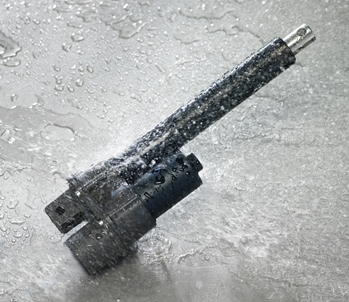
The Max Jac® electric linear actuator is designed to endure the harshest environments. It is rated for IP66/IP69K and has been tested for 500 hours of salt spray.

The operating temperature range of the Max Jac® stretches from -40 to +85 °C which is the greatest range of any actuator on the market.
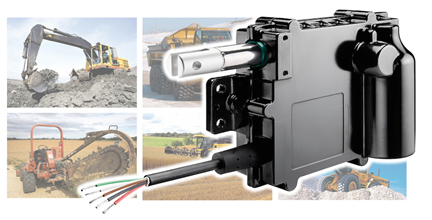
The compact Elektrak® Throttle actuator simplifies installation, increases operator safety and can significantly reduce energy costs with superior controls optimized to dynamically manage engine speeds.
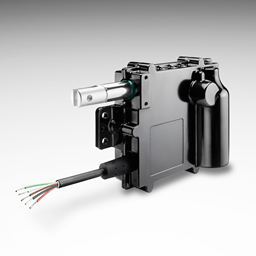
The rugged aluminum housing offers IP69K/IP67 sealing and is e-coated for corrosion resistance to make the throttle actuator virtually maintenance-free.